

 SynBio Cambridge
 CAMBRIDGE
invalid location provided

Compiled by Jim Haseloff at the University of Cambridge.
This site contains details of recent papers and activity in Synthetic Biology, with particular emphasis on: (i) development of standards in biology and DNA parts, (ii) microbial and (iii) plant systems, (iv) research and teaching in the field at the University of Cambridge, (v) hardware for scientific computing and instrumentation, (vi) tools for scientific productivity and collected miscellany.
Technology is driving revolutionary changes in biology. Over the past decade, scientists and engineers have begun to define the path forward in the genomic era. Systems Biology has arisen...
Now that we know the sequences of many genomes, from a wide variety of organisms and even from individuals with unique characteristics, many researchers have turned to making intentional...
The developments within synthetic biology promise to change the world in significant ways. Yet synthetic biology is largely unrecognized within conservation. The purpose of the meeting...
(Re-)constructing and Re-programming Life This conference will provide an in-depth discussion forum among practitioners of the various fields underlying Synthetic Biology. It aims to...
The BioBricks Foundation is pleased to announce The BioBricks Foundation Synthetic Biology 6.0 Conference (SB6.0), which will take place on July 9-11, 2013 at Imperial College, London,...
This course will focus on how the complexity of biological systems, combined with traditional engineering approaches, results in the emergence of new design principles for synthetic...
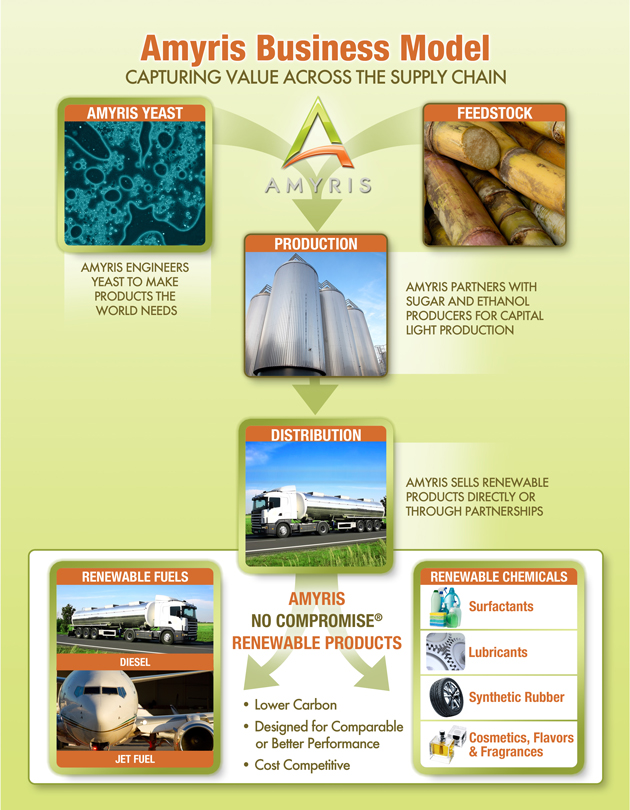
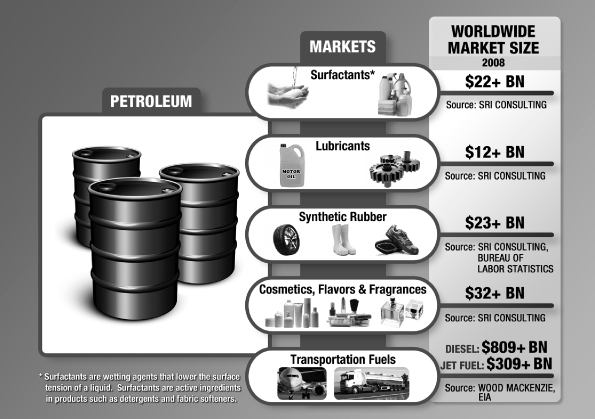
BLOG REPORT FROM GREENTECHMEDIA by ERIC WESOFF: APRIL 16, 2010 see http://www.greentechmedia.com/articles/read/amyris-files-to-go-public-biofuels-from-microbes/ In February, Michael Kanellos suggested that Amyris would be the next greentech startup to file to go public. It pains me greatly to write that he was correct. The synthetic biology firm, which has raisedmore than $244 million in private funding from Kleiner Perkins Caufield & Byers, Khosla Ventures, TPG Biotechnology, Advanced Equities, DAG Ventures, Grupo Cornélio Brennand, Naxos Capital Partners, The Westly Group, Stratus Group, and Temasek Holdings, et al. filed its SEC paperwork today and is looking to raise $100 million. Here's the link to the S-1. The company, which was spun out of research conducted at UC Berkeley, feeds sugars to custom microbes which exude hydrocarbons to order which are then converted to fuels or industrial chemicals. The CEO, John Melo, told Greentech Media in 2008 that $2 per gallon wholesale biodiesel was achievable. According to the S-1, Melo made $408,333 in salary, $200,000 in bonus, and $221,617 in other compensation for a total of $829,950 in 2009. The first product out of the company was an artificial version of artemisinin, an antimalaria drug that drew millions in support from the Bill and Melinda Gates Foundation. (Images from the S-1)
Amyris Files to go Public—Biofuels from Microbes
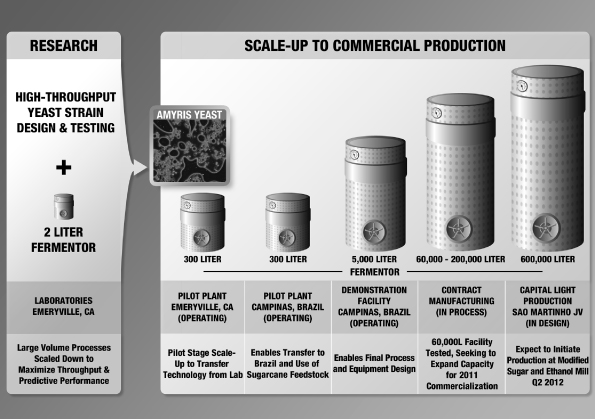
The company has been busy. In December, it paid $82 million to Brazil's São Martinho Group for a 40-percent stake in an ethanol mill project that the parties hope will be operational by 2011 or 2012. The Brazilian company already controls three ethanol plants that make about 600 million liters (158 million gallons) of ethanol per year. Soon after, it entered into agreements with three other Brazilian companies -- Acucar Guarani, Bunge Limited and Cosan -- to produce ethanol and high-value chemicals.
Here are some tidbits from the SEC document:
Background
Risks
Amyris lists a confidence-sapping set of risks, standard for this type of document, which include:
Revenue
The company had 2007 sales of $6.1 million, 2008 sales of $13.9 million and 2009 sales of $64.6 million. The profits from those years were, just kidding -- the company lost $11.7 million, $41.8 million and a whopping $64.4 million in 2009.
Another biotech, company, Codexis, which makes enzymes for fuel production filed its S-1 in December. Vinod Khosla, an investor in Amyris, has voiced concern that "too many companies have filed and we will get a nanotech moment." He's "much more concerned about premature IPOs" and cites Codexis as "pretending to be a biofuels company when it is an R&D firm."
How is Amyris any different?
PhD Studies in Cambridge
The Board of Graduate Studies manages admission of the University's graduate students. Prospective students should start here - for an introduction to the University of Cambridge, the courses we offer, how to apply for postgraduate study, how your application will be processed, and immigration and other important information.
Click here for more information about Cambridge
